



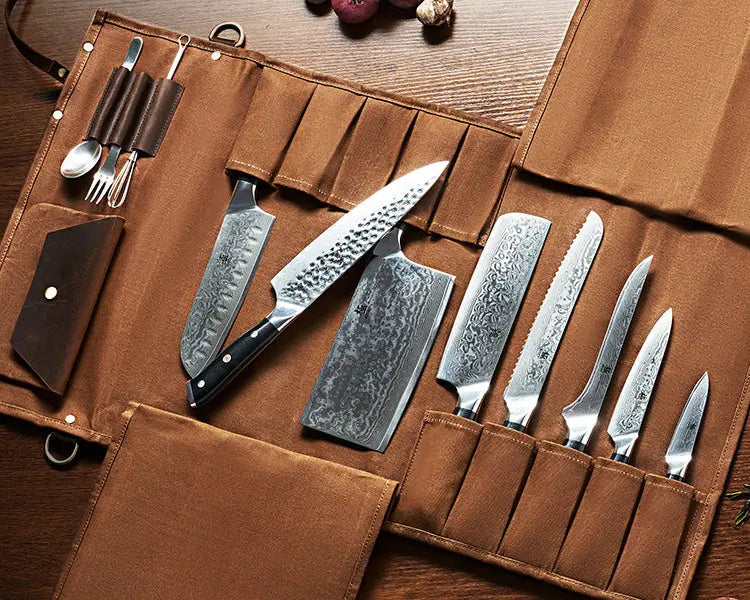
When you spend some time in a professional kitchen setting, one thing you quickly realize is that chefs don’t choose their kitchen knives based on how many they can own or afford: they choose based on efficiency and purpose.
A chef’s approach to choosing the best knives is rather simple: it is better to have fewer knives, but use them better; each knife must earn its place, and comfort and reliability matter more than brand or appearance.
The wisdom behind how chefs choose the best knives (and why they use them) is so valuable. Even if you are just cooking dinner a few nights a week, choosing the right knife can elevate your entire experience and make you more confident in the kitchen.

What Knives Do Chefs Actually Use?
Professional chefs tend to stick to a small, carefully chosen lineup of knives that each serve a clear purpose. Usually, there is a chef’s knife, a paring knife, a bread knife, a utility knife, and a boning knife.
These five knives are important to chefs because they comfortably cover all the different types of cutting tasks they are most likely to undertake in a kitchen, no matter what they are cooking.
1. Chef’s Knives (The Workhorse)
If most chefs could only pick one knife, it would be a chef's knife, and that's because it is extremely versatile. It is a workhorse. Chefs use it for a multitude of cutting tasks on different materials: chopping vegetables, slicing meat, mincing herbs, and general all-purpose prep
When buying a chef's knife, professional chefs prioritize three main features:
- Comfortable handle and balance
- Blade length (typically 8–10 inches)
- Sharpness and edge retention

Many chefs say a good chef’s knife should feel like an extension of your hand. It should give you maximum control and consistency. Kyoku’s 8" Gyuto Chef Knife is made with high-quality 67-layered stainless Damascus steel, which is arguably the best steel for a chef knife.
At 8 inches, the blade length is perfect, and its edge has been handcrafted to a mirror polish at 8-12° double-sided using the traditional 3-step Honbazuke method to give you the efficiency required of a professional chef’s knife.
2. Paring Knife (The Precision Tool)
Pairing knives are small, nimble, and incredibly useful, which makes them a second favorite to many chefs. A paring knife is essentially the knife a chef reaches for when a chef’s knife feels too big. They are mostly used for peeling fruits, trimming and detail work, and other tasks like deveining shrimp.
The best paring knives for chefs usually have a lightweight feel to them, with a fine tip for precision. It must also be easy to maneuver and able to retain its sharpness.
Consider the 3.5" Damascus Paring Knife from Kyoku. It weighs merely 4 oz. and will get the job done flawlessly. It has a gorgeous herringbone pattern on the base of the tang, a touch of ancient Japanese design that gives it a unique look in your kitchen.
This fruit paring knife is ideal for mincing herbs, slicing fruit, peeling vegetables, cutting cheese, etc.
3. Bread Knife (The Serrated Specialist)
Though it mainly excels when it comes to cutting bread, a bread knife is not just for bread, which is why chefs love it. They generally use bread knives for slicing crusty bread without crushing it, cutting tomatoes or delicate produce, and handling foods with tough exteriors and soft interiors.

The best bread knives for chefs almost always feature sharp, durable serrations, a long blade for clean slices, and a comfortable grip for the sawing motion required to cut bread crusts.
Enhanced with ionic silver coating, this 8" Bread Knife VG10 Damascus Steel is professional
professional-grade and designed to deliver unparalleled performance and hygiene for all your baking needs.
4. Utility Knife (The In-Between Option)
A utility knife sits right between a chef’s knife and a paring knife, and chefs generally use it for all manner of mid-sized tasks like slicing sandwiches, cheese, or smaller produce. Now, utility knives are essential, but many chefs use them because they are simply incredibly convenient to use.
Generally, chefs prefer utility knives to have a lightweight but sturdy feel, as these are suitable for different tasks.
5. Boning Knife (For Meat and Fish Work)
Designed for breaking down proteins, boning knives are absolutely treasured by chefs who have to work with meat. A boning knife allows them to remove bones from meat or fish and trim fat and sinew.
The best boning knives for chefs usually have a sharp, narrow profile with a flexible or semi-flexible blade for control over tight cuts. This 7" Boning Knife from Kyoku is made of VG10 Damascus Steel and coated with silver iron to prevent contamination as you debone, prepare, fillet, skin, trim, and butterfly all your favorite meats.
 Professional Chefs vs. Home Cooks: What’s the Difference?
At a glance, you may not notice any difference between the knives professional chefs use and the knives home chefs use. That's because the difference mainly lies not with how the knives look, but in how they are used (and chosen).
- Professional Chefs use their knives for hours every day, and so they prioritize durability and edge retention. Hence, a professional chef invests in knives made from higher-end materials and prefers knives that match their specific workflow
- A home cook, on the other hand, uses their knives less frequently and so generally prioritizes versatility over specialization. Usually, a home chef cares more about ease of maintenance and would prefer knives with user-friendly designs.
It is for this reason that a professional chef might own multiple versions of the same knife type, but a home cook usually just needs one good version of each essential.
Best Knives: Professional Chefs vs. Home Chefs
| Knife Type | Best for Professional Chefs | Best for Home Cooks |
| Chef’s Knife | High-end, specialized, multiple sizes | One high-quality, versatile option |
| Paring Knife | Precision-focused, often several styles | One reliable, easy-to-use knife |
| Bread Knife | Heavy-duty, long-lasting serration | One durable serrated knife |
| Utility Knife | Frequently used for speed and efficiency | Optional but helpful |
| Boning Knife | Essential for butchery and prep work | Only needed if handling raw meat often |
What the Best Knife Set Looks Like
Chefs have a habit of building their own collection of knife sets over time. This is usually a combination of the knives that the chef uses the most often and knives that they have been particularly impressed by over the years. At a minimum, a chef's knife set usually includes:
- A high-quality chef’s knife
- A paring knife
- A bread knife
Occasionally, it might also include a utility knife, a honing rod for maintenance, and a storage solution (block, roll, or magnetic strip). Kyoku's simple and affordable 2-piece Japanese kitchen knife set includes a 7" boning knife and an 8" chef's knife. This dynamic duo lets you tackle everything from deboning to chopping, making meal prep easier and more efficient.
Final Thoughts on the Best Knives for Chefs
The knives chefs use aren’t complicated; they’re intentional. Each one has a purpose, and together they create a system that makes cooking smoother, faster, and more enjoyable.
For home cooks, the takeaway is simple: you don’t need a massive collection. You just need the right tools, chosen with the same mindset chefs use every day, practical, efficient, and built to last. Once you experience the difference a good knife makes, it’s hard to go back.
You may also be interested in this guide on 6-inch vs 8-inch chef's knives for some important, nuanced points to consider as you choose which best fits your needs.

