



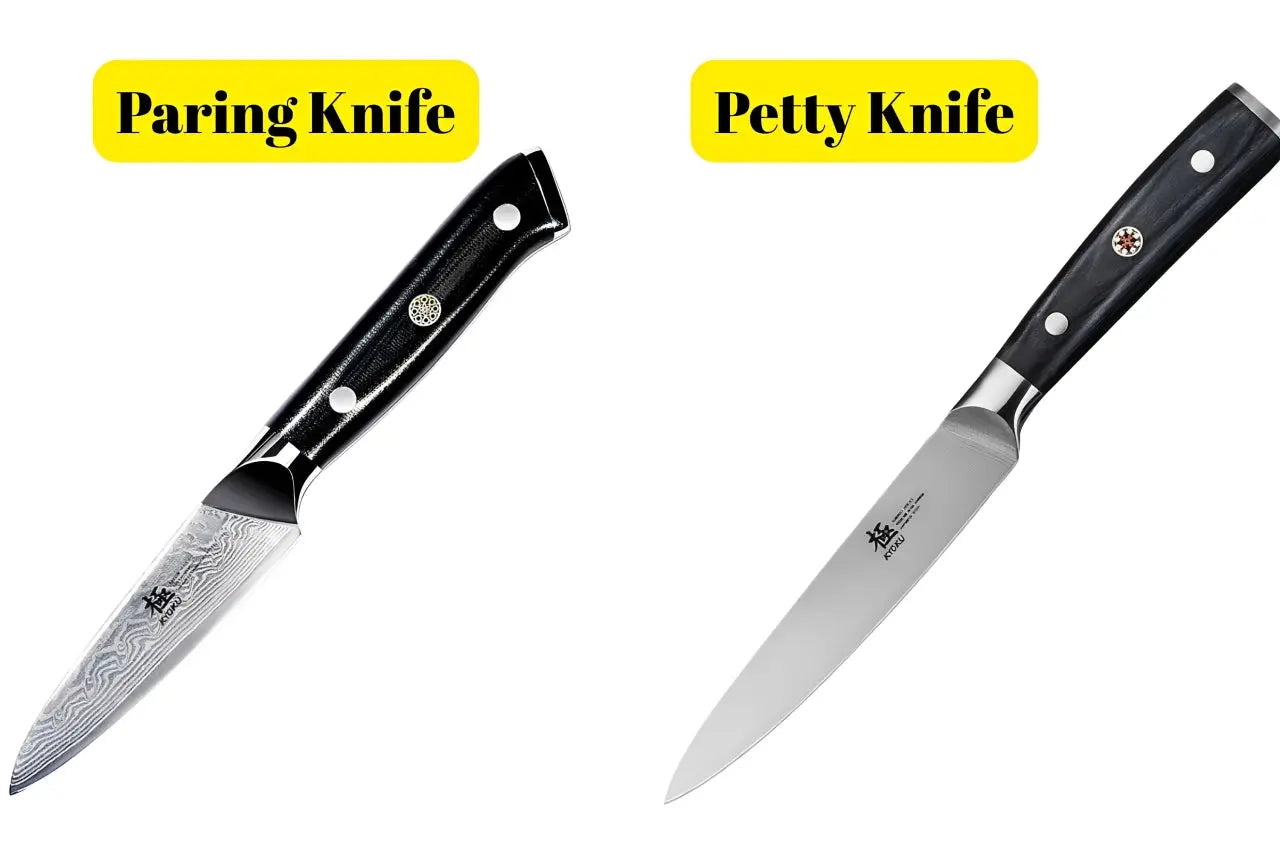
When you are new to kitchen knives, it is very easy to assume that a paring knife and a petty knife are essentially the same. First of all, both are smaller than a chef's knife, but also, they are both very obviously made for precision work, and you have very likely seen them both used for fruits, vegetables, and small ingredients.
However, these are only the areas in which they overlap. In truth, a paring knife and a petty knife are designed with different purposes in mind, and you don't really understand those differences until you have gotten the chance to use both (well… or read a blog about them).
While some tasks can be performed by either knife, others are significantly easier when using the tool specifically designed for the job.
So, even if you are “just a home cook”, understanding the difference between a paring knife and a petty knife will help you avoid buying the wrong knife, improve your food preparation efficiency, and build a knife collection that actually suits your cooking style.

Paring Knife vs Petty Knife: Key Differences
Once you start looking deeper and comparing the dimensions and intended uses of a paring knife and a petty knife, the differences become clear. Usually, you can tell by their differences in length, primary work zone, blade profiles, and the amount of knuckle clearance you get when using each.
1. Length: A Paring Knife is Shorter
One of the easiest ways to distinguish a paring knife from a petty knife is by blade length.
- A typical paring knife usually measures between 2.5 and 4 inches (6–10 cm).
- A petty knife is generally much longer, commonly ranging from 4.5 to 6 inches (12–15 cm), though some models extend beyond that.
The advantage of that additional length is that it gives the petty knife greater versatility and reach. With a 3-inch paring knife, you can easily peel an apple, but if you want to slice several apples into wedges on a cutting board, a 5.5-inch petty knife is what you need.
2. Primary Work Zone: In-hand vs. Cutting Board
Perhaps the biggest difference is where the knife is designed to be used. Paring knives are primarily intended for in-hand work. This includes tasks like peeling and coring tasks like peeling potatoes, hulling strawberries, or segmenting citrus fruits, where you normally hold the food in one hand while the knife is manipulated with the other.
Petty knives are primarily intended for cutting board work. They can indeed be used for in-hand cutting work, but the longer blade length makes it excellent for tasks like slicing shallots, cutting herbs, and trimming meat, where the food/ingredients are resting on a cutting board.
This distinction alone often determines which knife feels more natural for a particular task. Many users emphasize that a paring knife's lack of length is its main feature: it gives you a thumb-guided pivot point for detail work. A petty knife is more like a mini-Gyuto (Japanese chef's knife).
 3. Blade Profile
Paring knives typically feature shorter, narrower blades with pronounced points. Their compact design is meant to optimize control and maneuverability over cutting volume. The blade of a paring knife will also remain relatively narrow from heel to tip, mainly to allow precise cuts in tight spaces.
Petty knives have longer blades with profiles that more closely resemble miniature chef's knives or utility knives.
Also, the blade of a petty knife may have more edge length and a gentler curve compared to a paring knife. This is a profile that allows for smoother slicing motions and more efficient control on a cutting board.
There are many home cooks who note that a 135mm or 150mm petty knife often becomes a "lazy daily driver" for small meals, replacing both the chef's knife and the paring knife for quick tasks.
4. Knuckle Clearance
Knuckle clearance is another major difference between a paring knife and a petty knife. Paring knives generally offer no or very little knuckle clearance because they are not intended for extensive cutting board work.
What this means is that if you attempt to chop vegetables on a board with a paring knife, your knuckles will likely hit the cutting surface.
Petty knives provide noticeably more clearance. They don't offer as much room as a chef's knife or santoku, but they are much more comfortable for board-based slicing and trimming tasks. This is what makes the petty knife significantly more practical for extended prep work.
Paring Knives vs Petty Knives (Key Differences Summarized)
| Feature | Paring Knife | Petty Knife |
| Typical Length | 75 mm–100 mm (3 – 4 inches) | 120mm – 150mm (4.7 – 6 inches) |
| Primary | In-hand (peeling, coring) | Cutting Board (slicing, small prep) |
| Blade Profile | Narrower, shorter, flatter, flush with the handle | Taller, slight belly/curve, mini-chef shape |
| Knuckle Clearance | None (fingers hit the board) | Minimal to moderate (allows board work) |
Paring Knives: Small, Precise, and Incredibly Useful
The paring knife is one of the most specialized knives you will find in a kitchen. In truth, it lacks the versatility of larger knives, but there are certain tasks that it performs exceptionally well.
If your cutting tasks include a lot of detailed handwork and require a blade that allows you to make delicate cuts with minimal effort and excellent accuracy, this is most likely the knife you need. Many professional chefs still rely on paring knives despite having access to dozens of specialty knives because nothing else offers the same level of control for intricate tasks.
Best Uses for a Paring Knife
Paring knives excel at:
- Peeling fruits and vegetables
- Coring tomatoes
- Hulling strawberries
- Removing blemishes from produce
- Deveining shrimp
- Trimming small garnishes
- Creating decorative cuts
- Segmenting citrus fruits
A chef's knife may handle the larger cuts, but a paring knife is often the better tool for removing seeds, peeling kiwi, trimming pineapple eyes, or creating decorative fruit shapes. These jobs demand precision more than cutting power.
Petty Knives: The Bridge Between a Paring Knife and a Chef's Knife
If the uniqueness of a paring knife is that it specializes in precision handwork, the uniqueness of a petty knife is that it specializes in versatility. The petty knife originated in Japan as a smaller utility knife capable of handling many of the tasks that would be awkward for a full-size chef's knife.
Its combination of compact size, longer blade, excellent maneuverability, and superior cutting board performance, which makes it a highly adaptable tool.
Many cooks find that a petty knife feels faster and less intimidating than a large chef's knife while still providing enough cutting length for everyday prep.
What Is a Petty Knife Used For?
Petty knives are excellent for:
- Slicing fruits
- Cutting vegetables
- Portioning cheese
- Trimming meat
- Preparing sandwiches
- Cutting herbs
- Slicing garlic and shallots
- Light protein preparation
For example, if you're making a quick lunch, a petty knife can comfortably handle slicing tomatoes, lettuce, portioning chicken breast, and preparing fruit without needing to switch to a larger knife. This versatility is one reason many professional cooks keep a petty knife within easy reach.
Using a Paring Knife and a Petty Knife Together
Many people assume they must choose one knife or the other. In reality, these knives complement each other extremely well. A good approach (which many people use) is to split your budget unequally. There are two ways you can go about this:
1. Use the Paring Knife Strategy
Start by buying a cheap, entry-level paring knife for under $15. The logic here is that paring knives take a beating, get lost easily, and don't benefit as much from high-end steel because they don't impact a cutting board. So, you can get a cheap paring knife and a really good petty knife if you are on a budget.
2. The Petty Knife Strategy
Splurge on a high-quality Japanese petty knife (such as the Kyoku or a Tojiro DP Petty) in the 135 mm–150 mm range. Because a petty knife handles board work like slicing garlic, shallots, and trimming meats, high-performance steel makes a massive difference.
If you want to choose between them, think about your workflow. If you prefer to peel potatoes and apples while holding the food in the air, get a cheap paring knife. If you want a nimble blade to slice small items on a board without pulling out a heavy chef's knife, invest in a petty.
 Final Thoughts on Paring Knives vs. Petty Knives
A paring knife excels at precise in-hand tasks such as peeling, trimming, and decorative cutting, while a petty knife thrives on the cutting board, offering greater versatility and slicing performance. Understanding their differences in length, work zone, blade profile, and knuckle clearance helps make choosing the right knife much easier.
For many cooks, the best solution is not choosing one over the other but using both. The petty knife handles most small-to-medium prep tasks, while the paring knife takes over when precision becomes critical. Together, they form a highly effective combination that can make everyday food preparation faster, safer, and more enjoyable.
You may also be interested in what a petty (utility) life is used for in the kitchen.

