



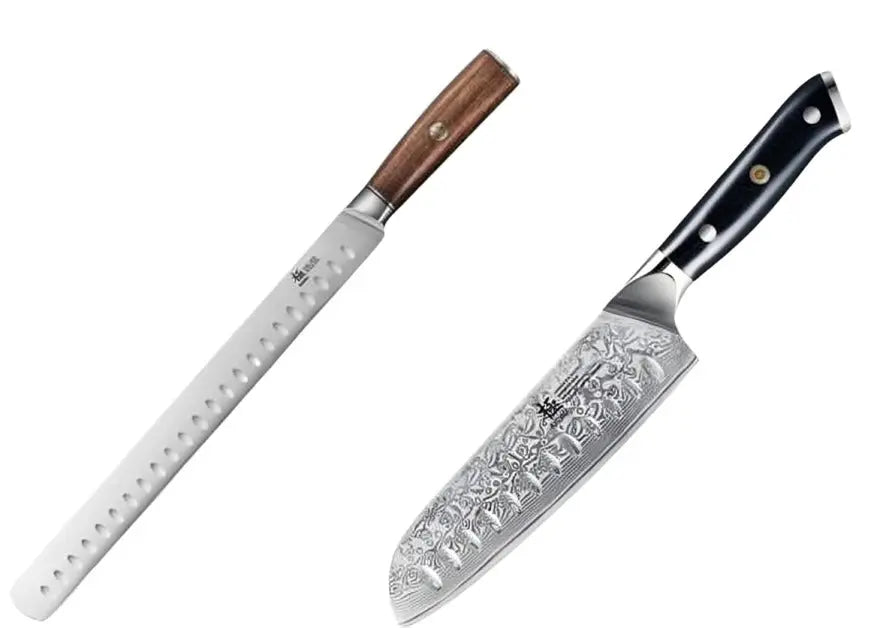
If you are not very familiar with kitchen knives in general, it is easy to mistake a knife with dimples as a sign that it offers a better performance or is more durable. In reality, these “dimples” are purpose-specific features that help in certain situations, and make little difference in others.
That’s why it’s important to understand not just why some knives have dimples, but what role they actually play.
Let’s break it down so you can see when they matter, and when they don’t.
 Why Do Some Knives Have Dimples (and Others Don’t)?
The main role of knife dimples, formally called grantons or hollow edges, is to improve how food interacts with the blade, specifically to reduce friction and sticking.
- When you slice certain foods like potatoes, cucumbers, cheese, and meat, they tend to stick to the blade.
- This happens because of the moisture released from the food, surface tension, or the smooth contact of the blade.
Knife dimples resolve this problem by creating tiny air pockets between the blade and the food. This reduces suction and helps slices fall away more easily.
Why Not All Knives Have Dimples
The reason some knives have simples while others don't is quite simple: not all knives need them. It all depends on the purpose and design of the knife.
Knives do not need dimples if:
- They are designed for precision. For 3.5-inch paring knives and other types of knives that are needed primarily for fine slicing or detailed cuts, precision matters more than release. Dimples may get in the way of their primary use.
- The blade is thin enough already: Certain types of knives (Nakiri knives, for example) have thin blades that naturally reduce sticking without needing dimples. Dimples are not needed.
- The food being cut doesn’t stick much anyway. Knives that are used for foods like dry herbs or dry ingredients do not need dimples. Manufacturers generally do not add them.
- Structural strength is prioritized. Adding dimples slightly removes material from the blade
In summary, manufacturers include dimples only when the trade-off makes sense.
Knives With Dimples vs Without: Key Differences
| Feature | Knives With Dimples | Knives Without Dimples |
| Food sticking | Reduced sticking | More sticking (depending on food) |
| Cutting smoothness | Smoother with sticky foods | Depends more on blade sharpness |
| Precision | Slightly reduced (in some cases) | Typically higher precision |
| Blade strength | Slightly less material in the blade | Full blade strength |
| Maintenance | Slightly harder to clean (indentations) | Easier to clean |
| Best use cases | Slicing vegetables, meats, sticky foods | Fine cutting, detailed prep |
| Aesthetic appeal | More distinctive look | Cleaner, traditional appearance |
Which Knives Have Dimples (and Why)?
1. Santoku Knives
Santoku knives have dimples because they are mainly used for foods like fresh vegetables and meats that tend to stick. Since they are mainly used for slicing, dicing, and chopping, the dimples help:
- Reduce drag when slicing
- Prevent thin slices from clinging to the blade
- Improve overall cutting rhythm
This is probably the most common knife where dimples are genuinely useful.
In addition to its deep, even, and effective dimples, Kyoku's 7" Santoku Knife (made of VG10 Damascus Steel) has a protective silver ion coating to prevent the growth of unwanted contaminants for extra culinary safety. It provides the perfect blend of tradition and technology in your kitchen.
2. Slicing Knives
Slicing knives are often used for carving meat, which tends to stick, hence they need dimples. When slicing meat (especially cooked meat), you want clean cuts, with minimal tearing, and slices that fall away easily.
The dimples on slicing knives essentially make this possible because:
- They help reduce friction on long slicing strokes
- Separate slices cleanly
- Improve presentation (very important for carving)

Kyoku's 12" Brisket Slicing Knives feature a 12-inch multipurpose carving knife that blends tradition and tech. They are made of cryo-treated Japanese VG-10 steel for durability and also have the ionic silver coating for hygiene. Their razor-sharp edge delivers precise, even slices, while blade indentations prevent food from sticking.
3. Some Chef’s Knives
Not all chef knives have dimples, but some do. Chef knives are general-purpose tools, and dimples are added to improve performance with sticky foods. In a chef's knife, dimples play two important roles:
They help with potatoes, squash, and similar foods
They reduce the need to constantly wipe the blade
That said, many high-end chefs’ knives skip dimples entirely and rely on blade geometry instead.
4. Utility Knives (Occasionally)
Some utility knives also have dimples, and that is because they handle a mix of foods, including items prone to sticking. The dimples on a utility knife (those that have them) play three major roles:
- They improve versatility
- Make quick slicing tasks smoother
- But this is more of a bonus feature than a necessity.

How Important are Knife Dimples?
Though they are important in santoku knives and a few other types of kitchen knives, dimples should not be a primary factor when you are considering which knife to get.
Rather than focusing on dimples, pay attention to the blade geometry. The shape, thickness, and grind of the blade have a bigger impact on performance than dimples. A well-designed knife without dimples can outperform a poorly designed one with them
Knife dimples are helpful only in specific situations, like slicing starchy vegetables or carving meat. If that’s not what you do often, you won’t notice much benefit. For most knives, dimples are a “nice-to-have feature,” not a "must-have". Think of dimples as a performance enhancement, not a requirement.

Final Thoughts on Knife Dimples
Dimples on knives are sometimes a necessary design feature that reduces friction and helps food release more easily. But they’re not universally necessary.
For a Santoku or slicing knife, the dimples may be necessary, but they mostly shine in slicing tasks, especially with sticky foods, and are less important for precision or general-purpose use
At the end of the day, the best approach is simple: Choose the knife for the job first, then decide if dimples are a helpful bonus.
Here are some important tips on how to choose the best santoku knife for kitchen use.

