Now that you’ve found the knife that best fits you, what’s next? As time goes by, you start to have a harder time yielding perfect slices, which could be frustrating. What’s more, a dull knife can be seriously dangerous.
That being said, an important part of owning any knife is its maintenance, in other words, keeping your knife sharp. Here’re some of these tips and tricks which are helpful to enhance the durability of your knives.
Whetstones
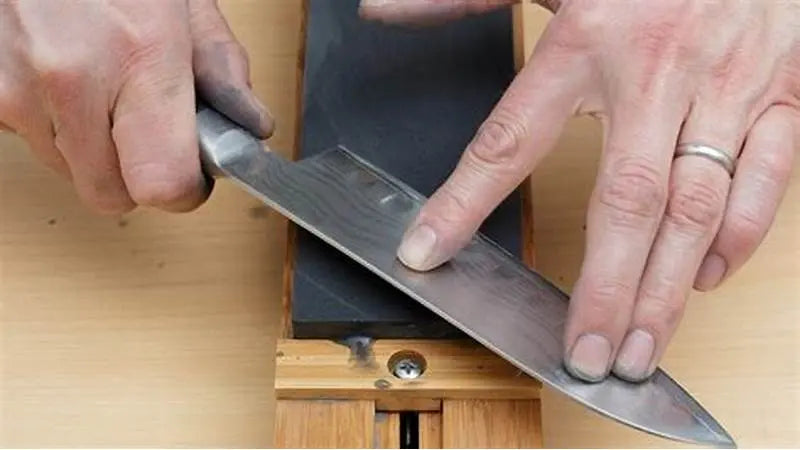
Some get intimidated by the idea of sharpening knives with whetstones. But If you’re all about that precision, you know that you’ll need it from time to time. Now let’s walk through the process.
preparation
Before you start, soak your stones in water for about 5 to 10-minutes.
Next will be finding the right angle. As a general guide, Japanese kitchen knives are typically sharpened to 17-degrees. Once you’ve successfully found the right angle, maintain it throughout the sharpening process. Otherwise the edge will be ruined, and you will have to start the sharpening process all over again.
Sharpening
To start sharpening, draw the knife towards you once you have found the angle, with the edge facing away from you. Pull the knife across the stone. When you draw it back, ensure that the entire length of the blade is pulled across the stone in a single stroke. As you draw the knife across the stone, apply a little pressure.
At the end of each drawing stroke of the blade across the stone, examine the edge to see how you are doing.
Examine
After every 4 or 5 strokes across the stone, try to feel for the burr on the edge. When the knife is beginning to sharpen, it’s edge will curl over slightly . Scratch your fingernail down the sharp edge opposite to the side you have been sharpening. If it feels like it hooks on the edge, this means the burr has developed.
Once the burr is evident across the entire length of the knife’s edge, it’s time to repeat the process on the opposite side!
A little more
For your first time, start with an old knife so you wont worry about messing up! Remember to focus on the angles and check for the burr when sharpening. Take your time, and don’t rush the process.
Manual/ Electric Sharpeners
A manual knife sharpener is a more affordable way to maintain your kitchen knives while an electric knife sharpener is much more powerful and precise, as the abrasives of electric knife sharpener are on motorized wheels that spin against the blade. The process is also easier:
1. Pull the knife through the course slot of the sharpener, from the heel to the tip, using even pressure, three to six times (pull through more times for more dull or damaged knives). For electric knife sharpeners, just let the motorized abrasives do the work!
2.Finish with one or two pulls through the fine grit side.
Honing Steel Rods
These long, metal rods exist to correct the edge of the blade on the knife before and post usage. It is the perfect gadget for aligning and repositioning your knife. It is commonly used to correct a chef knife. All you have to do is the following:
1. Stand the honing rod up on a counter or table, perpendicular to it, and position the knife edge at a 15 degree angle to the rod.
2. Sweep the blade along the steel, switching sides, until it realigns the edge.
Store 'em right
Once you've gone through the trouble to sharpen and hone your treasured knives, make sure you store them right so that they stay pristine for longer!
Frequently Asked Questions
1. How often should I sharpen or hone my kitchen knife?
You should hone your knife frequently and fully sharpen it once it no longer holds an edge despite honing.
2. What’s the difference between honing and sharpening?
Honing realigns the edge of the blade and keeps it sharp, whereas sharpening actually removes metal to create a new cutting edge.
3. What kind of cutting board should I use to keep my knife sharp?
Use wooden or plastic cutting boards that are gentler on the blade. Avoid hard surfaces like glass, stone, or metal, which can dull or damage the knife edge.
4. Should I put my high-quality kitchen knives in the dishwasher?
No. High-quality knives should be hand-washed immediately after use with warm water and mild detergent, then dried thoroughly to prevent corrosion and maintain edge sharpness.
5. How should I store my knives to preserve their sharpness?
Store your knives in a dedicated block, on a magnetic strip, or in sheaths, avoiding loose drawers. This helps prevent chipping, edge damage and dulling caused by contact with other items.
6. What obvious signs mean my knife needs resharpening?
If the knife starts tearing rather than cleanly slicing food, requires extra force, or fails paper-slice tests (if you use them), it’s time to resharpen. A good knife should glide through food easily.
7. Can I use any sharpener for my Japanese-style or premium kitchen knife?
Be cautious: Japanese-style knives often require specific angles (e.g., around 17° per side) and correct technique with whetstones. Using generic or pull-through sharpeners may damage the edge geometry.
Hello, my name is Edward Thompson and I'm a writer who loves Japanese food and culture. I went to a great cooking school in New York and have been to Japan several times to learn more about Japanese cooking and knife culture. I know all about Japanese knives, from their history and how they're made to how to use them.