



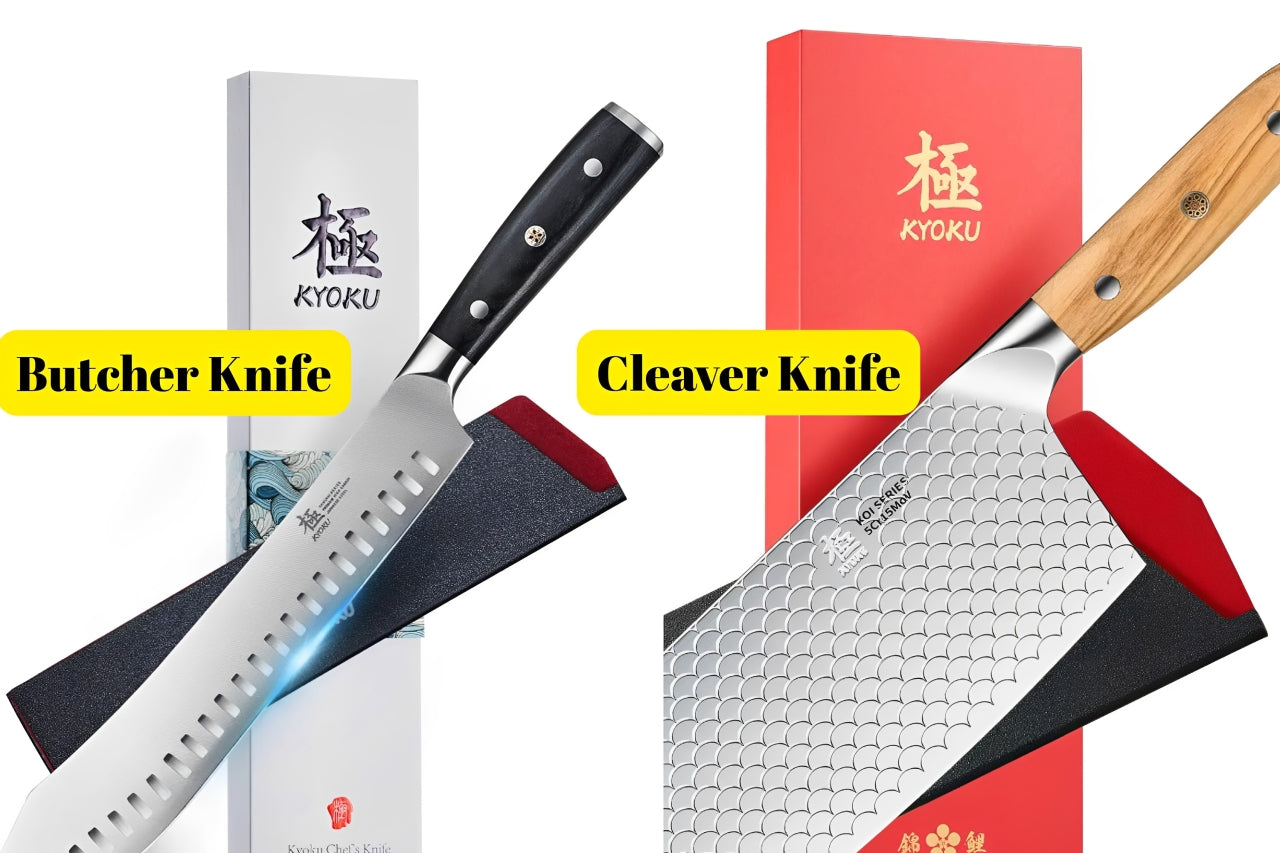
Understanding the differences between a cleaver knife and a butcher knife is one of those pieces of knife knowledge that will help you work faster, protect your blades, and get cleaner results, especially when you are trying to break down a whole hog or prep a weeknight roast.
At first glance, these kitchen knives might seem interchangeable: both are large, both are built for meat, and both look like they mean business. But once you pick them up, you start to notice the differences, and it will not take you long to realise that these are very different tools designed for very different jobs.

What Exactly is a Cleaver Knife? Key Features and Best Uses
The cleaver knife is one of the oldest and most recognisable knives in the culinary world. What makes it instantly recognisable is its wide, rectangular blade (usually 6-9 inches long), substantial weight, and blunt spine.
In terms of physical appearance, a cleaver knife looks more like a small axe than a kitchen knife. It was designed to do something that most knives simply can't: cut through bone.
5 Key Features of a Cleaver Knife
1. Blade Shape: Tall, Flat, and Rectangular
The cleaver's blade is tall, flat, and rectangular. This shape is very important to how a cleaver knife works because it does a few things at once.
It gives the knife a large cutting surface, making it easy to use the flat of the blade for smashing (garlic, for instance),
It keeps the cutting edge parallel to the cutting board throughout a chop.
The blade typically ranges from 6 to 9 inches in length, with a height that gives the knife a distinctly imposing profile.
2. Weight: Cleavers are heavy by design
Most cleaver knives fall between 1 and 2.5 pounds. That weight also plays a crucial role when using the knife. When you bring a cleaver down, the mass of the blade does the work for you. You're not really pushing or pulling through material; you're dropping controlled force onto it.
This weight makes the cleaver uniquely effective at splitting joints, cracking ribs, and chopping through cartilage.
3. Extra Blade Thickness
Cleaver blades are thick, often 3 to 6 millimetres at the spine. This thickness is what gives the blade the structural strength to handle bone contact without bending, chipping, or cracking under impact. A thin blade would flex and fail the moment it hit hard resistance.
4. Edge Angle (Large, Obtuse Edge)
Cleavers typically have a relatively obtuse edge angle, often between 25 and 40 degrees per side. The steeper edge angle creates a more durable, impact-resistant bevel, one that holds up to the force of chopping through bone without rolling or chipping. This way, you sacrifice some sharpness for a lot of toughness.
5. Steel Type: Usually Carbon Steel
Most quality cleavers are made from high-carbon stainless steel or carbon steel. The goal is a steel that can absorb impact without fracturing.
Very hard, brittle steels that hold razor edges are actually less desirable in a cleaver because they're more likely to chip under force.

5 Best Uses of a Cleaver Knife
Cleaver knives are best used for cutting tasks that involve force and bone. Here are the five principal uses of a cleaver knife:
-
Splitting bones and joints: Whether you're separating chicken thighs, cracking a rack of ribs, or splitting a beef shank, the cleaver handles bone contact that would destroy most other knives.
-
Chopping through cartilage: Joints, knuckles, and connective tissue are no match for a well-swung cleaver.
-
Breaking down whole poultry: Running a cleaver through the backbone of a chicken or duck is faster and cleaner than using kitchen shears or a boning knife.
-
Rough-chopping vegetables: On a busy prep line or in a home kitchen, the wide flat blade makes short work of cabbage, squash, and root vegetables that would slow down a thinner blade.
- Chinese-style cooking prep: In Chinese culinary tradition, the cleaver (caidao) is an all-purpose tool used for slicing, mincing, scooping, and smashing, a tradition that reflects just how versatile a well-designed cleaver can be.
Who is a Cleaver Knife For?
The cleaver is the right tool for home cooks and professionals who regularly work with whole or bone-in cuts of meat. If you're buying whole chickens, breaking down ribs, or dealing with any cut where bone is part of the equation, a cleaver belongs in your kitchen.
It's also ideal for cooks who prefer efficiency over delicacy.
The cleaver isn't a precision instrument; it's a workhorse. If you want to get from a whole duck to portioned pieces quickly, the cleaver is your friend. It's less ideal if you need fine, controlled cuts or are working with delicate proteins.
What is a Butcher Knife? Key Features and Best Uses
The butcher knife is a longer, more agile blade that is designed to move through large cuts of meat with grace. Where the cleaver excels for tasks requiring force, the butcher knife works through reach, curve, and controlled slicing motion.
It's the knife a professional butcher reaches for when trimming, slicing, or fabricating sub-primal cuts into retail portions.

5 Key Features of a Butcher Knife
1. Blade Shape: Long, Curved
The butcher knife has a long, curved blade (usually 8 to 14 inches) that sweeps upward toward the tip. This curve is intentional, and it plays a crucial role when you use the knife.
It creates a rocking motion when slicing, allowing the blade to draw through meat in long, fluid strokes rather than straight up-and-down chops. The tip is pointed, and that is what gives the knife the ability to pierce and start cuts precisely.
2. Weight: Lighter than cleavers
Slicing knives weigh between 0.5 and 1 lbs. The goal is control and manoeuvrability, not mass. Think about it: a heavy knife would tire out a butcher working through dozens of cuts per hour. The lighter weight lets the operator guide the blade with precision over long periods.
3. Blade Thickness: Thin Blades for Precision
Slicing knife blades are typically 2 to 3 millimetres at the spine, even though they are still thicker than most kitchen slicers.
This gives them enough rigidity to move through large cuts of meat without flexing excessively, while remaining nimble enough for detailed work like seam butchery, where you're following the natural separations between muscle groups.
4. Edge Angle: Fine Angles
Butcher knives are sharpened to a finer angle than cleavers, usually 15 to 22 degrees per side.
This sharper bevel gives the blade the ability to slice cleanly through muscle fibre without tearing, which matters both for efficiency and for the appearance of the final cut. A cleaner slice means better-looking retail portions and less cell damage to the meat.
5. Steel Type: Usually Carbon Steel
Butcher knives are often made from high-carbon stainless steel that balances edge retention with the ability to be frequently re-sharpened using a honing steel. Professional butchers touch up their edges multiple times per shift, so the steel needs to respond well to honing rather than requiring full sharpening every time.

5 Best Uses of a Butcher Knife
The butcher knife is best used for cutting tasks that call for length, control, and a clean slice rather than force. Go for a butcher knife in any of these five scenarios:
- Trimming fat and silverskin: The long blade makes it easy to run a continuous cut along a muscle seam, removing fat caps and connective tissue in smooth, efficient strokes.
- Fabricating large sub-primals: Turning a beef loin or pork shoulder into individual steaks and chops requires long, confident cuts through substantial pieces of meat, exactly what the butcher knife is built for.
- Seam butchery: Following the natural seams between muscle groups to separate cuts without bone saws or cleavers is skilled work, and the butcher knife's pointed tip and curved blade are ideal for navigating those connective tissue boundaries.
- Slicing boneless roasts: For large boneless cuts like a leg of lamb or a whole tenderloin, the butcher knife produces cleaner, more consistent slices than shorter knives or cleavers.
-
Breaking down large carcasses (boneless sections): After a band saw or cleaver has dealt with the bone, a butcher knife takes over for all the muscle work.
Who Is a Butcher Knife For?
The butcher knife is the right tool for anyone who regularly works with large, boneless (or already-deboned) cuts of meat.
If you're trimming brisket for a barbecue competition, portioning a whole tenderloin, or fabricating steaks from a sub-primal, a quality butcher knife will make that work dramatically faster and cleaner.
It's also ideal for home cooks who buy larger cuts and break them down at home, a practice that saves significant money compared to buying pre-portioned steaks and chops. A butcher knife, paired with a cutting board and a little know-how, gives you the ability to do that work confidently.
Cleaver Knives vs Butcher Knives: Key Differences at a Glance
| Feature | Cleaver Knife | Butcher Knife |
| Blade Shape | Wide, rectangular blade with a flat cutting edge parallel to the spine. | Long, curved blade with a pronounced belly and pointed tip. |
| Primary Motion | Vertical chopping motion that relies on blade weight and gravity to split materials. | Horizontal draw cuts or push cuts that glide through meat with controlled pressure. |
| Best Cutting Action | Splitting, chopping, and breaking through hard materials. | Slicing, trimming, portioning, and processing meat. |
| Performance on Meat | Effective for cutting through meat and bone, but less precise for clean slicing. | Produces cleaner cuts that preserve muscle fibres and improve presentation. |
| Edge Angle | Relatively obtuse edge, typically 25°–40° per side, to withstand heavy impacts. | Finer edge, typically 15°–22° per side, optimised for smooth slicing. |
| Edge Durability | Highly resistant to chipping and rolling when striking bone. | A more delicate edge that can be damaged by hard impacts. |
| Bone Contact | Specifically designed for repeated contact with bone and dense connective tissue. | Not designed for bone contact; even occasional contact can damage the edge. |
| Construction | Thick, heavy blade built to absorb impact. | Thinner, lighter blade optimised for manoeuvrability and precision. |
| Ideal Uses | Splitting bones, breaking down large cuts, processing poultry, and performing heavy-duty butchery tasks. | Trimming fat, portioning meat, slicing roasts, and preparing boneless cuts. |
| Simple Rule of Thumb | If the task involves bone, choose a cleaver. | If the task involves boneless meat, choose a butcher knife. |
Choosing Between a Cleaver Knife and a Butcher Knife: Essential Tips
Now that the differences are clear, choosing between a cleaver and a butcher knife comes down to understanding your own cooking habits and the kinds of tasks you regularly face. Here's how to think through the decision:
1. Start by auditing the work you actually do.
Be honest about what ends up on your cutting board most often.
- If you frequently buy bone-in cuts (whole chickens, racks of ribs, bone-in pork shoulders) and you find yourself wrestling with them using the wrong tools, a cleaver will immediately change your experience.
- If you mostly work with boneless cuts and your frustration is with imprecise, ragged slices on large pieces of meat, a butcher knife is the answer.
Don't assume you need to choose just one. In a well-equipped kitchen, these two knives complement each other perfectly.
A butcher knife without a cleaver leaves you unable to handle bone. A cleaver without a butcher knife makes fine trimming and long slicing work unnecessarily difficult.

2. Consider your knife skills and comfort level.
The cleaver requires a decisive, controlled chopping motion and a solid understanding of where to aim on a joint or bone. Used carelessly, it's the least forgiving knife in the kitchen.
If you're newer to breaking down meat, a butcher knife is generally more forgiving; a misaligned cut can be corrected, whereas a misaligned cleaver chop is harder to recover from. Build your skills with a butcher knife first if you're still developing confidence.
3. Think about the size of cuts you typically work with.
- If you cook for a small household and mostly buy pre-portioned cuts from the grocery store, an 8-inch butcher knife will likely cover your needs without requiring a cleaver at all.
- If you regularly buy in bulk, whole primals from a restaurant supply store, or large holiday roasts that you break down yourself, both tools earn their place.
4. Match the knife to the quality of your cutting board.
A heavy cleaver on a thin plastic board is a recipe for a cracked board and an unstable working surface.
If you're going to use a cleaver regularly, invest in a thick end-grain or edge-grain wood cutting board that can absorb impact without shifting or splitting. A butcher knife is far less demanding in this regard and works well on most surfaces.
5. Invest appropriately for your use frequency.
If you're using either of these knives daily or weekly, quality matters; a well-made cleaver or butcher knife from a reputable maker will last decades with proper care.
If you're buying one for occasional use, a mid-range option will serve you fine without requiring a major outlay.
What's rarely worth it is buying a very cheap version of either knife: bargain cleavers tend to have thin blades that chip on bone, and budget butcher knives often use soft steel that loses its edge after a few uses.

Final Thoughts On Cleaver vs Butcher Knives
At the end of the day, the cleaver and butcher knife represent two different philosophies of working with meat: one built on force, the other on finesse. Understanding that distinction, and knowing when to reach for which, is what separates a cook who struggles through a whole chicken from one who breaks it down in under three minutes. Get clear on what your kitchen actually demands, choose accordingly, and keep both blades sharp. The right tool makes all the difference.

