



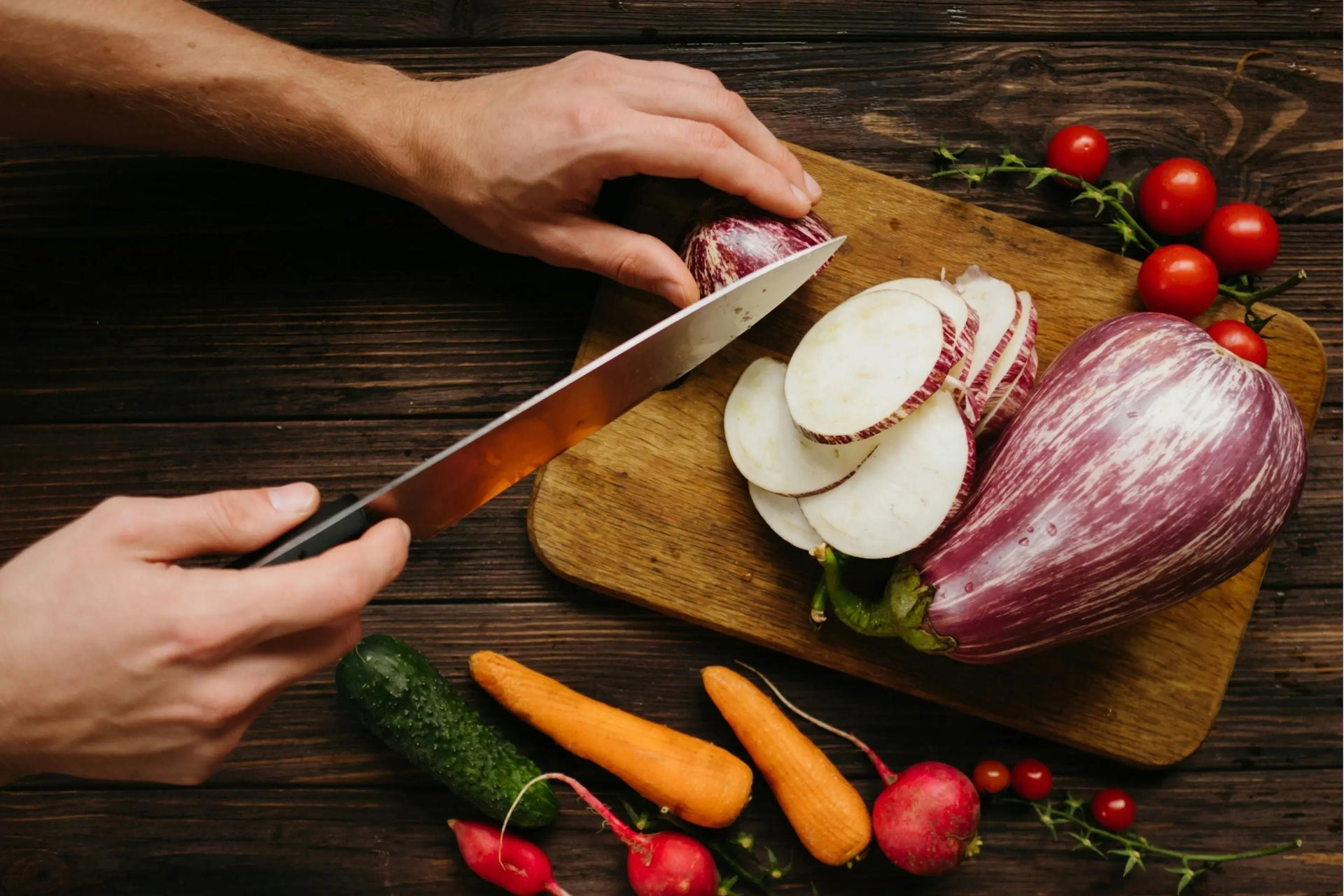
Fine dicing demands precision, and that is precisely why the kitchen knife you use matters. A bulky knife can crush ingredients, a dull knife can slip or tear, and the wrong blade shape can slow you down.
The right knife helps you cut cleaner, move faster, and create more uniform results.
So, your objective when choosing the best knife for fine dicing should be to use a knife that gives you control, comfort, sharpness, and accuracy. Fine dicing is less about brute force and more about finesse.

4 Best Types of Knives for Fine Dicing
The overall consensus is that thin, nimble Japanese knives are best for fine dicing. This mainly includes Gyuto knives and petty knives, specifically those with a fine tip. These blades are perfect for fine dicing because they slice cleanly without bruising ingredients and maintain enough versatility for all your prep work.
1 Gyuto (Chef’s) Knives
A chef’s knife is the strongest all-around option for fine dicing because it combines versatility, speed, and control. A good chef’s knife allows you to slice horizontally through onions, make vertical cuts cleanly, rock through ingredients smoothly, and handle both large and small produce.
It is especially effective when dicing onions, celery, peppers, carrots, and potatoes.
For fine dicing, look for a 7 to 8-inch blade with a thin to medium blade thickness and a sharp, pointed tip.
2. Santoku Knife (Best for Push Cutting Precision)
A Santoku knife ranks very close behind the chef’s knife for fine dicing. It is often lighter than a chef's knife, which makes it less intimidating for many home chefs.
A chef's knife offers great control on chopping boards, efficient for onions, cucumbers, zucchini, and herbs. It is particularly excellent for cooks who prefer straight downward cuts instead of a rocking motion, and its flatter edge and nimble feel make it excellent for repetitive vegetable prep.
Look for a santoku with a 6.5 to 7-inch blade with thin edge geometry, and a comfortable handle. If you like precision and a lighter feel, Santoku knives are outstanding.
3. Utility Knife (Best for Small Produce)
A utility knife is an underrated, but great knife for fine dicing. It works especially well on smaller ingredients like shallots, garlic, small onions, jalapenos, and small fruits where a full chef’s knife may feel oversized.
It is ideal for in-hand work and microscopic vegetable cuts, such as finely mincing garlic or shallots. Look for a utility knife with a 5 to 6-inch blade, a narrow profile, a fine tip, and an agile handle.
4. Nakiri Knife (Best for Vegetable Specialists)
A Nakiri knife is designed for vegetables and can be superb for fine dicing produce. Its straight blade profile creates clean vertical cuts with full board contact. Users who love Nakiri knives for fine dicing love their flat-edged, rectangular cleaver shape.
However, some users mention the lack of a pointed tip, which can make detailed onion dicing tedious. The best nakiri knives for fine dicing feature a 6-7 inch length, with a thin blade and a tall blade knuckle clearance and laser blade sharpness.

4 Best Japanese Knives for Fine Dicing From Kyoku
1. 8" Gyuto Chef Knife VG10 Damascus Steel
Kyoku’s 8-inch Gyuto Chef knife from the Shogun series boasts high-quality, easily sharpenable steel and a near-indestructible handle for fine dicing tasks. This gyuto chef knife slices vegetables effortlessly. The hammer-beaten wave pattern on the base of the tang showcases the stunning craftsmanship and its luxurious identity.
2. Kyoku’s 7" VG10 Damascus Steel Santoku Knife
Kyoku’s 7-inch Santoku Knife features a protective silver ion coating to prevent the growth of unwanted contaminants for extra culinary safety; the provided sheath and case allow you to preserve your knife with care. Its 7-inch multi-purpose blade delivers professional performance for home chefs and culinary experts alike
3. 6-inch VG10 Damascus Steel Utility Knife
The 6" Utility Knife from Kyoku is made of VG10 Damascus Steel and features a gorgeous, hammer-beaten herringbone pattern on the base of the tang, which not only shows off the stunning craftsmanship but also prevents food from sticking to the blade, making the kitchen utility knife practical for everyday use.
4. 7" Nakiri Knife VG10 Damascus Steel Silver-ion Coating
Kyoku’s 7" VG10 Damascus Nakiri Knife is made of VG10 Damascus Steel and features a cryogenically-treated VG-10 steel core (58-60 HRC) with Damascus cladding and ionic silver coating for exceptional durability and hygiene, delivering razor-sharp precision for vegetables, fruits, and boneless meats, complete with an ergonomic fiberglass handle and protective sheath for professional-grade performance in every slice.

The Role of Proper Technique in Fine Dicing
Many people assume a premium knife automatically creates professional knife cuts for fine dicing. It does not. A quality knife helps tremendously, but technique is what turns a sharp blade into consistent, fine dice.
- A great knife with poor technique will give messy results
- A decent, sharp knife with strong technique is best for excellent results
- The best combination is both a quality knife and sound technique
Fine dicing is about repeatable geometry. You are creating strips first, then cubes. If spacing is inconsistent early, the final dice will also be inconsistent. Technique also improves speed, safety, uniform cooking, and a cleaner presentation.
Best Techniques for Fine Dicing
- Master the “Push Cut.” The "push cut," which means moving the blade forward and downward in a diagonal motion at approximately a 45° angle to slice through an ingredient, is the best for a clean, professional fine dice
- Use a sharp knife. Sharp knives cut cleanly and predictably. Dull knives crush and slip.
Create flat surfaces first. Halve onions, trim vegetables, or square off rounded items so they sit stably. Stable ingredients are safer and easier to dice evenly.
- Use the claw grip. Curl your fingertips inward, and guide the knife with your knuckles. This improves control and protects fingers.
- Cut first into even planks, then sticks, then cubes. This staged process is the foundation of precise dicing.
- Let the knife do the work. Use smooth slicing or rocking motions rather than chopping aggressively downward.

Fine Dicing vs Regular Dicing
Fine dice create small, neat cubes, often around 1/8 inch or smaller. It is used when ingredients should blend into the dish, cook quickly, or distribute evenly.
Regular dicing, on the other hand, is larger, often around 1/2 inch or more, depending on context. Dicing is used when ingredient presence and texture should remain noticeable.
Fine Dicing vs Regular Dicing: Key Differences
| Feature | Fine Dicing | Regular Dicing |
| Cube Size | Small (about 1/8 inch) | Larger (about 1/2 inch typical) |
| Cooking Speed | Faster | Slower |
| Texture in Dish | Blends in | More noticeable |
| Precision Required | High | Moderate |
| Knife Control Needed | High | Moderate |
| Best Uses | Sauces, aromatics, garnish | Roasts, soups, hearty dishes |
Final Thoughts on the Best Knives for Fine Dicing
The best knife for fine dicing is usually a sharp, well-balanced chef’s knife, with Santoku and specialty vegetable knives close behind, depending on style preference. But the knife alone is only half the equation.
Fine dicing comes from combining the right tool with smart fundamentals: stable ingredients, proper grip, consistent spacing, and smooth cutting motion. If your goal is cleaner prep, faster cooking, and more professional-looking meals, mastering fine dicing with the right knife is one of the best kitchen upgrades you can make.
You may also be interested in how to slice an onion properly using the Julienne cut.

